

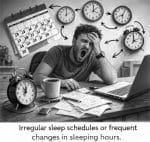
The Body Clock: A Biological Imperative That Modern Life Ignores
Deep within the hypothalamus, a small cluster of approximately 20,000 neurons called the suprachiasmatic nucleus (SCN) orchestrates one of biology’s most fundamental rhythms, the circadian cycle that governs the timing of sleep, wakefulness, hormonal secretion, body temperature, metabolism, and dozens of other physiological processes across the 24 hour day. This internal clock, synchronized primarily by light exposure but influenced by meal timing, physical activity, and social rhythms, has evolved over millions of years to align human physiology with the natural light dark cycle of the terrestrial environment. When lifestyle, whether through shift work, late night entertainment, transatlantic travel, variable work schedules, or simply inconsistent bedtimes, creates a misalignment between the clock’s biological programming and the actual sleep wake schedule a person maintains, insomnia is the predictable consequence.
The circadian clock drives sleep through two interacting systems. The homeostatic system accumulates sleep pressure throughout waking hours, the longer the wake period, the greater the adenosine driven pressure to sleep, and releases this pressure during sleep. The circadian system provides the timing signal that gates when sleep pressure translates into the ability to fall and stay asleep, controlling the release of melatonin from the pineal gland in the evening, the decline of core body temperature that facilitates sleep, and the morning cortisol surge that promotes waking. When these two systems are synchronized, when the circadian signal for sleep onset aligns with the accumulated homeostatic sleep pressure at the desired bedtime, sleep onset is relatively effortless and sleep quality is high. When they are misaligned, when a person tries to sleep at a time the circadian clock identifies as waking hours, insomnia results regardless of how tired the person subjectively feels.
The consequences of circadian disruption extend far beyond insomnia. Research from shift work populations and from the epidemiology of circadian rhythm disorder has linked chronic circadian misalignment to elevated risks of metabolic syndrome, cardiovascular disease, type 2 diabetes, depression, anxiety, and cognitive decline, making sleep schedule irregularity a systemic health risk rather than simply a sleep quality problem. These broader health consequences justify clinical attention to sleep schedule regularization as a preventive health intervention, not merely a sleep improvement strategy.
Shift Work Sleep Disorder and Social Jetlag
Shift work sleep disorder, affecting an estimated 10–38% of shift workers, represents the clinical end of the spectrum of circadian disruption driven insomnia. Shift workers whose schedules require sleeping during biologically designated wake times and working during biologically designated sleep times suffer a chronic circadian misalignment that the body cannot naturally overcome. Night shift workers trying to sleep during daylight hours fight against both the circadian clock’s light driven waking signal and the progressive dissipation of homeostatic sleep pressure that accumulated during the previous night’s wakefulness, producing fragmented, non restorative daytime sleep that typically provides only 60–70% of the sleep time achieved by day workers sleeping at night.
Social jetlag, a term coined by sleep researcher Till Roenneberg to describe the misalignment between an individual’s biological clock and their social schedule, affects an estimated two thirds of the Western population. The phenomenon is particularly pronounced in late chronotypes (natural night owls) who are required by social and occupational obligations to wake and sleep on a schedule incompatible with their biological clock. Social jetlag of as little as one to two hours has measurable health consequences, and the more extreme social jetlag of five to six hours common in strongly late chronotypes working standard daytime schedules produces health impacts comparable to chronic mild sleep deprivation.
For both shift workers and social jetlag sufferers, the insomnia challenge is not simply one of poor sleep habits, it is a mismatch between biological programming and life demands that behavioral interventions alone often cannot bridge. Pharmacological assistance in shifting or consolidating sleep to the required schedule, combined with strategic light exposure protocols and melatonin timing interventions, provides the most comprehensive clinical management approach.
Sleep Medications for Circadian Disrupted Insomnia: Clinical Applications
The pharmacological management of circadian disruption driven insomnia must account for the specific challenge: the problem is not simply inadequate sleep drive but the misalignment of the biological clock with the required sleep window. Medications that promote sleep through GABAergic or other mechanisms can bridge the gap between the circadian clock’s timing and the sleep schedule that life demands, providing the pharmacological override that enables sleep when the biological clock would otherwise maintain wakefulness.
Ambien (zolpidem) is frequently used by shift workers and travelers managing circadian disruption, providing reliable sleep onset facilitation in the 30–60 minute window following administration regardless of the circadian phase. The standard 5–10mg immediate release formulation assists with sleep onset for workers trying to sleep during circadian wake phases; the Ambien CR extended release formulation addresses the sleep maintenance challenge of circadian disrupted individuals who achieve sleep onset but cannot maintain sleep continuity as the circadian clock pushes toward wakefulness.
Zopiclone (sold internationally as Imovane) is valued for circadian disruption driven insomnia for its consistent sleep promoting efficacy and its clinically useful half life that provides full sleep period coverage without excessive next day residual sedation at therapeutic doses. For shift workers requiring alertness during their subsequent work period, the balance between adequate sleep duration and next shift alertness is a critical dosing consideration that zopiclone’s pharmacokinetics generally manage well. Patients who buy zopiclone online from a certified licensed pharmacy for circadian disruption driven insomnia receive a well established sleep medication with decades of clinical use in exactly this population.
Restoril (temazepam) provides benzodiazepine class sleep promotion with a half life of approximately 8–20 hours, making it appropriate for the full night sleep consolidation that irregular schedule workers need during their designated sleep periods. Its reliable efficacy for sleep maintenance insomnia, the fragmented sleep continuity that is characteristic of sleep taken against the circadian clock, makes it clinically appropriate for patients whose circadian disruption produces frequent awakenings rather than purely sleep onset difficulty. Purchase Restoril from a certified pharmacy under prescriber supervision for circadian disruption driven insomnia and discuss with your pharmacist the optimal timing for administration to maximize sleep consolidation during your specific work schedule.
Melatonin and Circadian Phase Shifting
Melatonin, the pineal gland hormone whose release is triggered by darkness and suppressed by light, is the molecular signal that synchronizes the body clock with the environmental light dark cycle. Exogenous melatonin, taken at specific circadian phase shifting doses and times, can shift the circadian clock’s timing forward or backward, making it a useful clinical tool for circadian disruption driven insomnia when used with appropriate timing guidance.
For delayed sleep phase disorder, the extreme late chronotype condition in which the biological clock is locked into sleeping and waking several hours later than desired, low dose melatonin (0.5–1mg) taken in the early evening, five to six hours before the desired bedtime, gradually shifts the clock earlier over days to weeks. This phase advancing effect is modest but clinically meaningful for patients with relatively mild delayed phase, providing the biological clock adjustment that enables gradual improvement in sleep onset timing without requiring indefinite sedative hypnotic use.
For shift workers transitioning to night shifts, strategically timed melatonin combined with light avoidance strategies during the morning hours can accelerate the partial circadian adaptation that reduces daytime sleep disruption. However, the circadian adaptation achievable through melatonin and light management is incomplete and slow, requiring days to weeks and never fully eliminating the circadian disruption of permanent night shift work. For acute sleep management during this partial adaptation period, sleep medications ordered from a certified online pharmacy provide the clinically necessary support while circadian adaptation proceeds.
Establishing Regular Sleep Schedules: The Most Powerful Intervention
For individuals whose insomnia is driven by voluntarily irregular sleep schedules, variable bedtimes, weekend sleep timing shifts, night owl habits inconsistent with morning obligations, the single most effective insomnia intervention is establishing and maintaining a consistent sleep wake schedule across all seven days of the week. The circadian clock adapts to consistent sleep wake timing over days to weeks, progressively aligning melatonin onset, body temperature decline, and cortisol suppression with the consistent bedtime, making sleep onset increasingly effortless and sleep quality progressively better as circadian alignment improves.
The consistency requirement, waking at the same time every morning regardless of the previous night’s sleep quality, is the element patients most resist, because it requires accepting a potentially difficult morning after a bad night rather than compensating with later rising. But it is precisely this consistency that rebuilds the circadian signal strength that irregular schedules have diluted. Sleeping in on weekends, however justified by accumulated sleep debt, shifts the circadian phase toward the delayed chronotype direction that makes Monday morning’s required rising time feel like jetlag, the social jetlag that weekend sleep schedule variation systematically produces.
For patients transitioning from highly irregular to regular sleep schedules, the initial days of schedule regularization are typically the most challenging, the circadian clock’s inertia makes falling asleep at the new consistent bedtime difficult before the clock has had time to resynchronize. This transition period is where pharmacological support from Ambien, zopiclone, Imovane, or Restoril provides genuine clinical value, bridging the gap between the intention to maintain a consistent schedule and the biological clock’s resistance to the change, allowing the schedule to be maintained long enough for circadian resynchronization to make it self sustaining. Cheap generic sleep medications through a licensed online pharmacy make this bridging pharmacological support financially accessible during the typically brief transition period that schedule regularization requires.
Practical Sleep Schedule Management Strategies
Beyond medications, several practical strategies support circadian alignment and sleep schedule regularization. Morning bright light exposure, spending 20–30 minutes in bright natural or artificial light within 30 minutes of the desired wake time, is the single most powerful circadian phase setting stimulus, reinforcing the clock’s morning signal and gradually advancing sleep timing in those who need an earlier phase. Evening light avoidance, reducing overhead lighting, using warm spectrum low intensity lighting, and avoiding bright screens in the two hours before bedtime, supports the melatonin onset that signals sleep readiness to the circadian clock.
The bedroom environment should be optimized for sleep onset at the consistent bedtime: cool temperature (65–68°F is optimal for most adults), complete darkness through blackout curtains or sleep masks, and quiet through earplugs or white noise where environmental noise is unavoidable. These environmental optimizations reduce the external barriers to sleep onset at the consistent bedtime, ensuring that circadian alignment is not undermined by an environment that makes sleep initiation unnecessarily difficult.
Strategic napping, if circadian disruption from irregular schedules has created significant sleep debt, should be limited to 20–25 minutes before 3:00 PM. Longer naps or later naps deplete homeostatic sleep pressure that is needed for evening sleep onset, and napping after 3:00 PM shifts the circadian phase toward later timing. These napping guidelines apply even for severely sleep deprived patients, the short, early nap provides acute alertness restoration without undermining the nocturnal sleep that schedule regularization requires to improve.
Related posts:
 Insomnia: Causes, Consequences, and Evidence-Based Treatment Options
 Insomnia Driven by Chronic Stress and Anxiety: Why an Overactive Mind Steals Your Sleep
 Screen Exposure Before Bedtime and Insomnia: The Blue Light Disruption of the Digital Age
 Pharmacological Mechanisms and the Evidence for Sleep Initiation Treatment